Showing posts with label renewable resources. Show all posts

Thursday, March 23, 2017

Delores Point / South Beaver Mesa

By Jerry Smith


March 22, 2017, the team of Tom/Connie and Jerry struck out for the Delores Point and South Beaver Mesa trails.  These trails are in the neighborhood of Gateway, CO.

After a quick stop in Gateway, we proceeded up the John Brown Road through John Brown Canyon.  It is a steep grade up a well-maintained county road through a deep and narrow red canyon.   

The Gateway Canyons Resort from Delores Point

After passing the Whirlwind Uranium mine, we proceeded out the Delores Point Mesa to GPS the routes that would be run for Rock Junction 2017.  Rock Junction is the Grand Mesa Jeep Club’s annual three-day trail event held the three days before the first Saturday in June.  That day is reserved for the Rocky Mountain Off Road Expo.

Up until we turned and started along the east rim of the mesa, all was good.  The rim section has severely overgrown trees reaching out well into the trail.  This slowed progress to a crawl and was very noisy as the branches screeched across the paint and top.  This will require several hours of trimming before we can offer this trail to our guests.

The Grand Mesa Jeep Club must annually pre-run no less than five trails before Rock Junction.  Winters and Spring can be very hard on many area trails.  Downed trees, rock falls, overgrown brush, and erosion can 
put a trail out of commission until we come along with the necessary maintenance.  Our guests come to drive the trails, not to do maintenance.
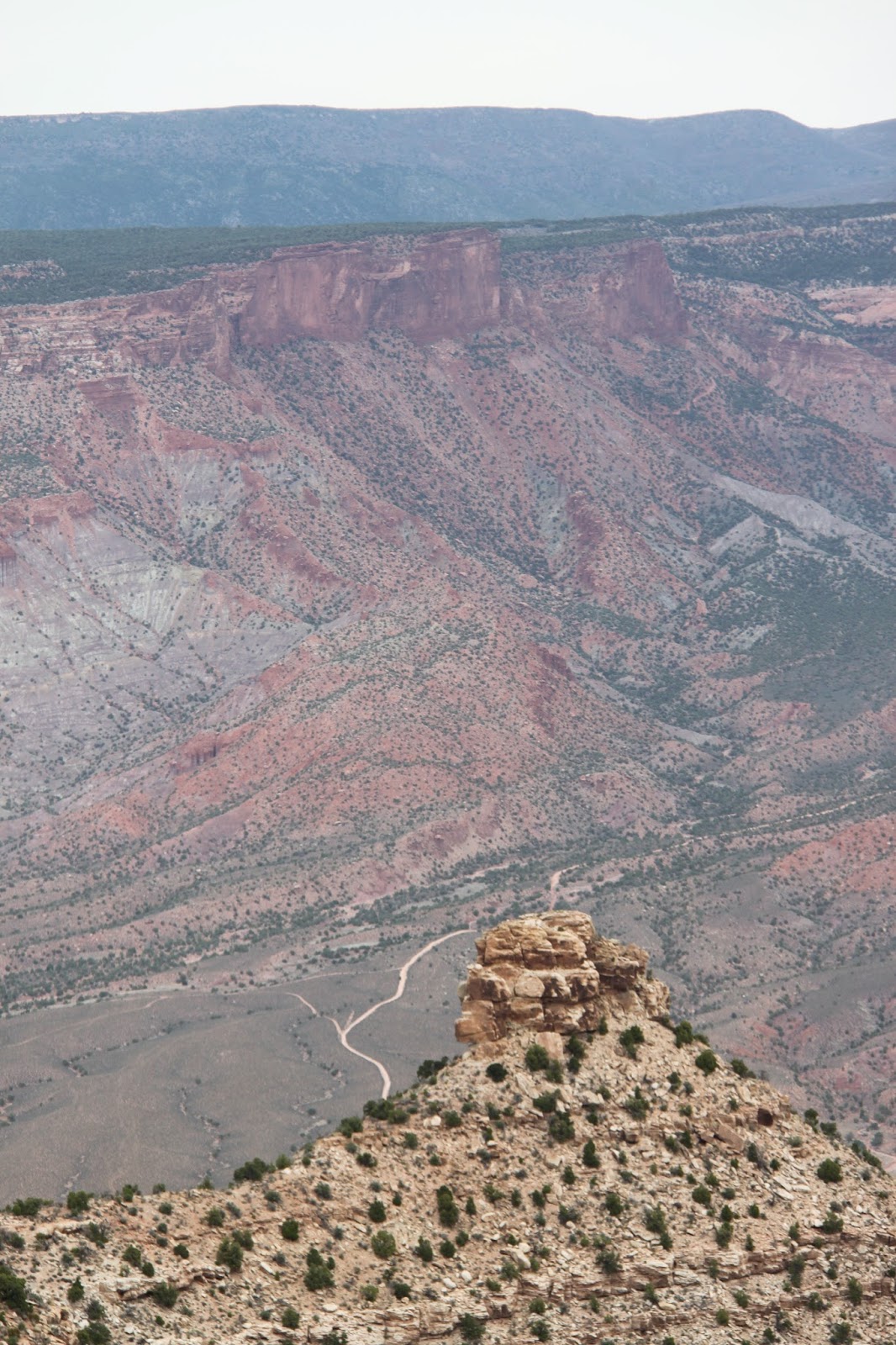
This is the Sheep Creek Trail.  The road easily seen in the bottom winds its way to just below the vertical cliffs at the top of the picture.  This narrow, steep shelf road can be a challenge in the spring due to erosion and rock falls.

 As it was, we picked up a hefty gunny sack full of cans and bottles along the trail and winched a large fallen tree from the trail.

The grand highlight of this trail comes at the end.  The views of the surrounding countryside are to die for.  Spectacular scenery greets your eyes in every direction.  If you are remotely familiar with the area, you will recognize many landmarks.

We could point out the Delores Overlook and the newly christened “Top II” trail where we had driven last Sunday.  Top II is the southern end of the up thrust mesa that graces the Top of the World trail of Moab fame.  From some viewpoints on Top II, you can see the terminus of Top of the World like nowhere else.

These spectacles from Delores Point made our lunches much more enjoyable.  Other trails seen from there include Sheep Creek, South and North Beaver Mesas, Polar Mesa, and the region around Rose Garden Hill.

Returning back from Delores Point, we continued to the South Beaver Mesa turn-off.  The South Beaver road starts out fairly mild and scenic.  But once you reach the hairpin turn, hold on to your seat --- tightly!!

Tom climbing the South Beaver Mesa trail.  Notice the severe erosion.

 From here, if you don’t like steep, narrow, loose rock, washed out with 2-foot deep channels, class 7 or 7+ shelf roads, now is a good time to just park and enjoy the scenery.  For the next mile or so, you WILL be paying close attention to your driving.

Off-camber, steep, and full of loose rock and sand, this trail WILL make you pay attention to your driving.  The scenery is over the top as well, IF you take a moment to notice.

 At the bottom of the steep part, there is an old shack and dugout cowboys or shepherds used -- we think.  It is set on the rim of the Beaver Creek Gorge in a beautiful setting.  In the dugout, you can still find bottled water and a can of Campbell’s Chicken Noodle soup that have been on the shelf for at least 7-years.

Stocked shelves in the Great American BackCountry are a rare find.

This is the "cow camp".  The small shed has a bunk bed while the dugout is stocked with bottled water and a can of soup.  A corral is to the right of the gate.
The dugout had a wood stove and bed springs for a short man.  Crutches still hang on the wall.


The road continues out So. Beaver Mesa, but is not very exciting as Jeep trails go.  So we began the slow, rough and rocky climb back out.

The trail is littered with fallen and erosion exposed rocks of varying size.

 At an intersection, we turned off the trail onto another faint road that brought us to another cabin and dugout.  This one was built mostly from area Juniper.  This is an unusual building material for a cabin.

Cabins built of Utah Juniper are rare finds.  That is cactus growing on the roof.

The dugout is also Juniper and a sod roof with cactus growing on it.  This would have been a pretty cozy place on a cold night.

The road continued in the general direction of the Gateway to Moab road, so we crawled along hoping it would take us all the way through.  Following my nose has often resulted in good things happening, and after quite a long time, we came to a familiar road that took us out to the road back to Gateway.

A herd of Mule Deer allowed a quick photo.

 Another superior day in the Great American BackCountry and another reminder of why I live by Yogi Berra’s “Yogi-ism”;  “When you come to a fork in the road, take it!”  That is where the adventure begins.


Copyright Happy Trails 4wd, 2017.  All rights reserved.

Tuesday, August 27, 2013

Things Are Not Always As Presented!


Things Are Not Always As Presented!

By Jerry Smith
August 23, 2013
The following came to me today as one of those Emails that friends and relatives send.  It had more meaning to me than the usual article for a variety of reasons I will share after YOU have an opportunity to read and think about what these words and pictures mean to you.
67 years later!


What happened to the radiation that ”Will last thousands of years?”

HIROSHIMA  1945


We all know that Hiroshima and Nagasaki were destroyed in August 1945 after the explosions of atomic bombs.
 However, we know little about the progress made by the people of that land during the past 67 years.

HIROSHIMA - 67 YEARS LATER


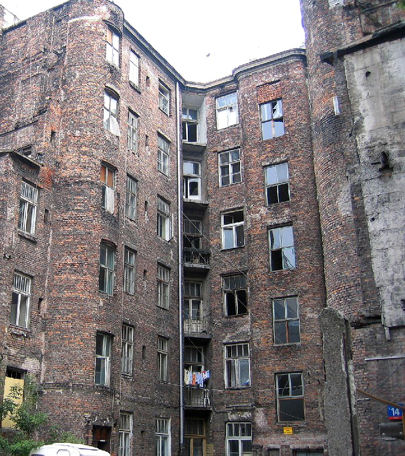
DETROIT- 65  YEARS AFTER HIROSHIMA


Which has caused more long-term destruction- 

The A-bombs
Or 

Government welfare programs created to buy the
 votes of those who want someone to take care of them?
Japan does not have a welfare system.
In Japan, you either work for it or do without. 

These are possibly the 5 best sentences you'll ever read and all are applicable to this experiment we call America:

1. You cannot legislate the poor into prosperity by legislating the wealthy out of prosperity.

2. What one person receives without working for, another person must work for without receiving.

3. The government cannot give to anybody anything that the government does not first take from somebody else.

4. You cannot multiply wealth by dividing it!

5. When half of the people get the idea that they do not have to work because the other half is going to take care of them, and when the other half gets the idea that it does no good to work because somebody else is going to get what they work for, that is the beginning of the end of any nation.

Can you think of a reason for not sharing this? Neither could I. 

Those pictures and few words no doubt raised a “political” thought or two for most of you.  I must admit, me too.  Those pictures “say” a lot!

But after a few minutes of thinking a little deeper, it came to me that my oldest daughter and her family live not far from both of these cities in Japan.  Their safety is of course paramount to me and all seems pretty safe judging by the building that has gone on.

As my mind tends to do, we shifted gears one more time to a whole new train of thought. 

Who is Right?


As many of you already know about me, Jeeping and Land Use are nearly a constant issue mulling over and over in my sometimes-hard head.  My head and heart have been working on this issue since the mid 1970s.

You are probably wondering; what the devil is he talking about?  How does this relate to Japan and “who is right about what?”  Please stick with me a minute or two as I try to explain.

As we have just seen and heard, sometimes people are pretty much exactly wrong when they are really sure they are right.  Add to that the fact that a lot (probably millions) of people jumped right up and joined the thinking that “Radiation will last thousands of years!”  It’s my guess that they were absolutely sure they were right.  The same was said about Chernobyl even after knowing what happened in Japan.

In my 60+ years on this world we have gone through times where millions of people believed we were entering the next ice age and now, a few years later, it’s “Global Warming” that is the big “world ending” “man caused” event.

Seems like it would be easy to call a healthy “Boloney!” (a kinder way of saying ‘Bull Crap’) on people who buy into these “crisis”.  Time has and likely will again prove them to be on the wrong side of the argument… yet many will never admit they have been wrong under any circumstances. For these people, there is little reason to argue with them. They know they are right and you'll never convince them of anything else.  Save your breath.

Since about 1960, we have had a growing number of people who firmly believe that “preserving” all public lands for some unknown future use is the proper, noble, and right thing to do.  They argue that we need to preserve more public lands for future generations and that motorized use of these lands is detrimental in about every way conceivable.

They seem perfectly content to lock away all the natural resources… both renewable and nonrenewable. 


Renewable Resources


One of the renewable resources that they insist on locking away has to do with motorized recreation. This renewable resource has never been proven to be of any grave detriment to any lands that I have ever heard of.   Even where some idiot drives into a muddy area leaving deep tracks over time will heal.

Depending on the particular area in question, roads and trails normally are less than 3% of the total area. In many cases they can be less than 1% of the total area.

Taking these percentages into account, common sense should dictate that motorized use of no more than 3% of any given area should have little to no detrimental environmental impacts.

Shall we ban all windstorms?


Granted that on any given backcountry trail or road, the passing of motorized vehicles will raise some dust, but take into account that on any day with exceptional wind present, tons of dust will be raised and deposited some were downwind… sometimes thousands of miles from where it was raised.  During these dust storms more material is lifted into the air than all the vehicles that have passed by for dozens of years could have raised. Shall we ban all windstorms?

Preservationists claims of motorized use causing extreme damage to both land and water quality are not only false, but extremely false!
That is not to say that motorized use does not contribute to these problems, but the extremity to which this contribution is made is so grossly exaggerated, you'd think it was the only cause.

Shall we ban all wildfires?


Take for example just one small area burned by wildfire. Erosion from just a few acres of one of these burned areas causes far more pollutants and siltation than hundreds of miles of backcountry roads and trails.  Is this a good reason to ban wildfires?

What about river systems?


Rivers such as the Colorado River, the Green River, the Mississippi River, and many others carry thousands of tons of silt and debris every day. No one knows how many digits to the right of a decimal point one would be before being able to measure the impact use of motorized recreation on backcountry roads and trails contributes to this pollution, but it seems logical that you would be many zeros from that decimal point. Does this mean that we should ban river systems?

Whether your chosen recreation in the great American backcountry has to do with motorized or non-motorized uses, nearly all uses come down to utilizing a road and or trail at some point in time. It would seem that we all participate in some level of the pollution process.

Even a hiker or equestrian leaves behind a certain level of pollution. (How many pairs of shoes have you worn out walking backcountry trails?) How does that worn synthetic sole fit into the natural environment? How about the steel in a horseshoe? Does the trail you use contribute to any increase in siltation and erosion?

Again I Ask; “Who is right?”